

Challenges and Results
Challenges
- For each deal, staff gathered information by hand across multiple tools, including a business card management system, an SFA (sales force automation) system, and the company's own product information
- Each sales activity required about 30 minutes of preparation
- The sales department had no staff capacity to lead the process improvement needed to fix this inefficiency
Results
- An AI agent built with Copilot Studio reduced sales preparation that had taken 30 minutes per deal to virtually zero
- Sales preparation was standardized, eliminating variation from one person to the next, and many highly positive comments came in from the front line
Before
Working across multiple tools, spending 30 minutes per deal on manual preparation
In the client’s sales department, staff prepared for sales activities by searching and organizing information deal by deal across several tools and materials, including a business card management tool, an SFA (sales force automation) system, and the company’s own product information. Each sales activity took about 30 minutes of work, and because the sales department had no staff capacity to lead the process improvement needed to fix this inefficiency, the underlying problem had never been resolved.
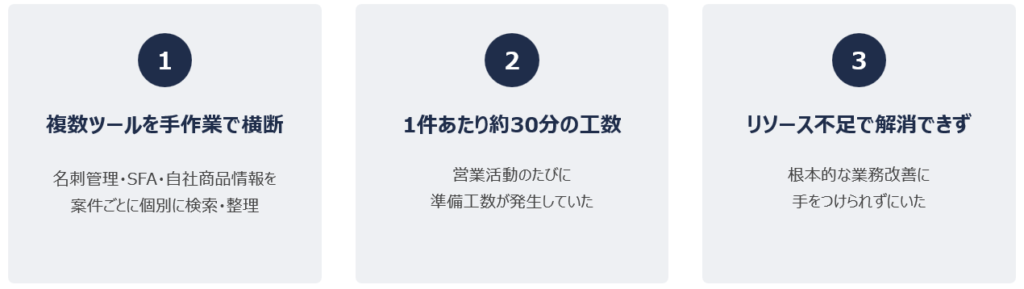
Figure: Three challenges of person-dependent sales preparation
Redesign
Building an AI agent in Copilot Studio to take advantage of its fit with Microsoft 365
The approach chosen was to build an AI agent using Copilot Studio. The client already used Microsoft 365 across the company. Other generative AI tools require large volumes of documents to be loaded each time, whereas Copilot Studio fits well with the existing environment, so a smooth rollout could be expected.
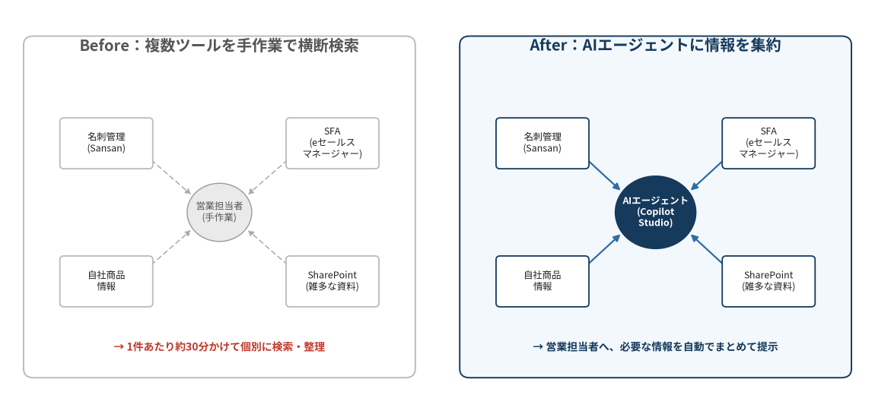
Figure: How the information-gathering flow for sales preparation changed
No-code development and integrated data sources
Copilot Studio is a no-code development environment similar to Power Automate. Development involves linking prebuilt processing components (topics and actions) into a flow and setting instructions and reference sources in each component’s properties.
Three information sources were connected as search targets in Copilot Studio: the business card management tool, the SFA, and the SharePoint site that holds the company’s product information. Work that once meant searching each of these separately for every deal was consolidated so that it can now be completed with a single question to the AI agent.
Turning abstract requirements into concrete ones through careful interviews
The initial requirement was only an abstract one: “Use AI to give us information we can use in our next proposal to a customer.” ITSO began with a series of interviews and carefully investigated how work was actually done on the front line. This revealed that the SharePoint folder originally described as holding customer information actually contained the company’s own product information instead, mixed with content that would act as noise and lower the accuracy of the AI agent’s answers. ITSO proposed rethinking how the data itself was stored and carried out the cleanup.
The project was run on a schedule that devoted the first month and a half to gathering requests, organizing requirements, and resolving issues, and the remaining half month to choosing the functions to implement and completing development and delivery. At the end of the month and a half spent on requirements, ITSO submitted a PoC with minimum functionality. ITSO also took on the role of explaining environment-related issues found along the way, such as license settings on the IT department’s side, using diagrams so that sales staff could follow, and of compiling these issues for reporting to and coordination with the IT department.
Hurdles overcome: vague requirements and a tight development setup
The first difficulty was that the initial requirements were very abstract. Interviews to understand what information actually existed on the front line took considerable time. In addition, the content of the data turned out to be very different from what had been assumed, so data cleanup was needed as groundwork before development of the AI agent itself could begin.
The client had no existing operating guidelines for Power Platform, and there was no culture of anyone outside the IT department building apps, so coordinating the environment took longer than expected. ITSO’s experience in helping develop Power Platform operating guidelines proved valuable in this coordination.
The project also revealed room for better advance preparation, such as confirming license and permission settings with the client and making requests in advance. These have become lessons for the next project.
After
Sales preparation work cut to virtually zero, with strong praise from the front line
As a result of the project, preparation for sales activities, which had taken about 30 minutes per deal, was reduced to a level close to zero. In addition, sales preparation, which had varied from person to person, was standardized, helping raise the overall quality of customer engagement.
If your organization is spending too much time on sales preparation across multiple tools, or sees uneven quality from one person to the next, we hope this case offers useful insights.