
Challenges and Results
Challenges
- The process from purchasing to invoicing had become a black box, and its actual state was unknown
- Exceptions that deviated from the standard process and stalled approvals occurred throughout
- The organization was so large that interviews with staff alone could not pinpoint the root causes (bottlenecks)
Results
- Cut 5,400 hours of work per year, or 30% of the 18,000 annual hours spent on the purchase ordering work analyzed
- Clearing process bottlenecks delivered annual cost savings of about ¥16.2 million
Before
Work on a scale too large to see where and why delays occurred
In the client’s purchasing department, staff handled the entire workflow, from requests and approvals to obtaining quotes, placing orders, confirming deliveries, processing invoices, and making payments. Each person handled the work differently, and overall workload kept growing. To the management departments, the process as a whole was a black box. They knew that exceptions outside the standard process and delays caused by pending approvals were occurring throughout, but they had no way to see what was actually happening.
Because the organization was large, with many departments and people involved in purchasing, its biggest challenge was that intuition and interviews alone could not identify the root causes (bottlenecks): which steps were delayed, and why. Without a clear cause, responses were left to the discretion of individual staff, and the work remained dependent on specific people.
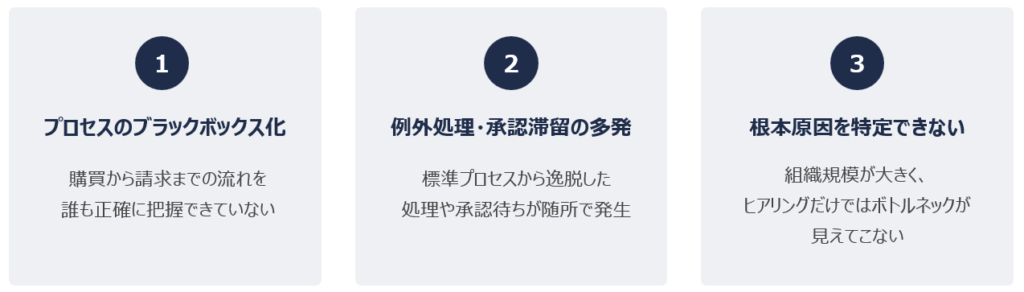
Figure: Three challenges in the purchasing process
Redesign
Analyzing event logs to pinpoint where delays and rework occur
To address this, ITSO introduced process mining. Process mining is a method for improving operations that uses event logs stored in core business and operational systems to visualize how processes actually run, and to analyze bottlenecks, rework, exceptions, and deviations from the standard process. By reconstructing who did what and when from the time-stamped activity logs in these systems, and visualizing the gap between the intended standard process and the actual flow, it objectively uncovers structural issues that are hard to see through interviews alone.
In this project, ITSO analyzed the entire workflow handled by the purchasing staff, from purchase requests and quotes to orders and invoices, and identified the following issues based on objective data.
- Work stalled while waiting for approval
- Delays in obtaining quotes and processing orders
- Rework in delivery confirmation and invoice processing
- Exceptions that departed from the standard flow
- Work concentrated on specific departments and staff
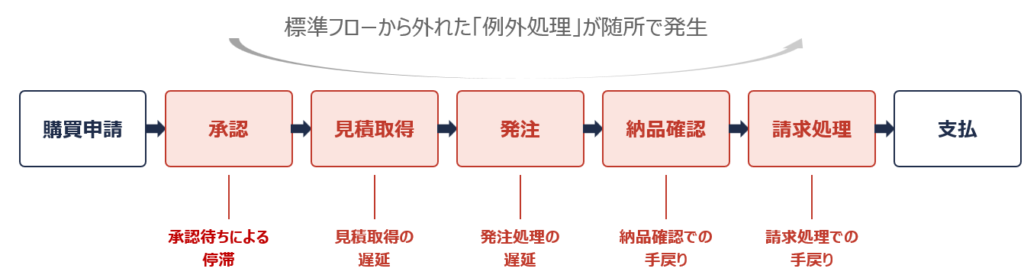
Figure: The purchase ordering flow and where bottlenecks occur
Visualizing these issues step by step made it clear which steps to address first. To reduce workload, ITSO then revised approval rules, standardized workflows, connected systems, and introduced automation.
After
5,400 hours saved, with annual cost savings of ¥16.2 million
The analysis started from a total of 60,000 working hours per year, based on 30 purchasing staff each working 2,000 hours annually (8 hours a day for 250 business days). The purchase ordering work analyzed in this project accounted for 30% of that total, or 18,000 hours. Event log analysis showed that inefficient work and rework, such as stalled approvals and exceptions, made up 30% of those 18,000 hours, and the project eliminated the corresponding 5,400 hours per year.
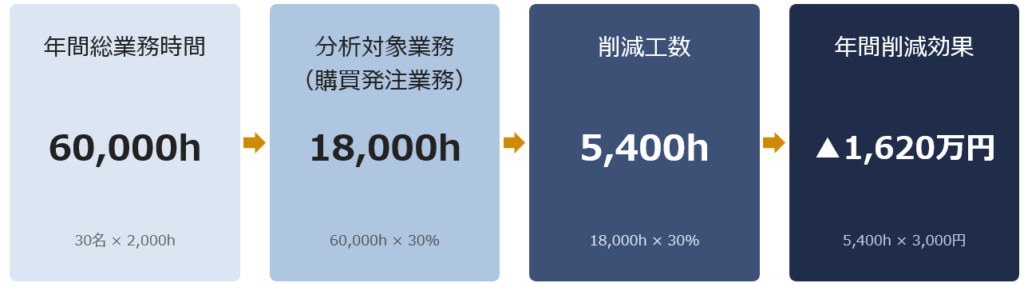
Figure: Breakdown of the savings
At an hourly rate of ¥3,000, the 5,400 hours saved translate into annual savings of about ¥16.2 million. Clearing the bottlenecks in the process directly cut unnecessary operating costs.
This project focused only on purchase ordering, but the patterns uncovered through process mining, namely stalled approvals, exceptions, and work concentrated on specific departments and staff, are likely common to other back-office functions such as accounting and HR. Applying the same approach to other processes could reveal further opportunities to reduce workload, identified through objective data.
If your business processes have become a black box and you are unable to identify the root causes objectively, we hope this case offers useful insights.