

Challenges and Results
Challenges
- With over 92% of US Fortune 500 companies already using generative AI, and over 58% of Japanese companies considering full adoption during FY24, falling behind on AI had become a management issue
- Existing AI tools sat outside everyday workflows, with no guidance on how or when to use them, so enthusiasm was not turning into actual use
- The client also compared SaaS AI tools, but none fit its needs in terms of security, cost, and integration with internal knowledge
Results
- ChatGPT-like usability and Teams integration brought registered users to about 80% of all employees
- Advantages in security and cost earned the platform recognition as a sustainable internal AI foundation
Before
A lack of real-world use was holding back adoption
More than 92% of US Fortune 500 companies have already brought generative AI into their operations, and more than 58% of companies in Japan are considering full adoption during FY24. As the competitive landscape changed rapidly, the client, a company in the automotive industry, found that falling behind on generative AI had become a management issue that demanded a quick response.
Employees themselves were receptive. However, the existing AI tools sat outside everyday workflows, and they had been rolled out without any concrete guidance on how to use them to help with work or in which situations to apply them. As a result, although there was real interest in trying AI across the company, that interest was not turning into actual use.
The client had also compared SaaS AI tools internally, but none fit its circumstances in terms of security requirements, ease of integration with internal knowledge, and the cost of adoption and maintenance. Building a company-wide platform and encouraging its use had become an urgent priority.
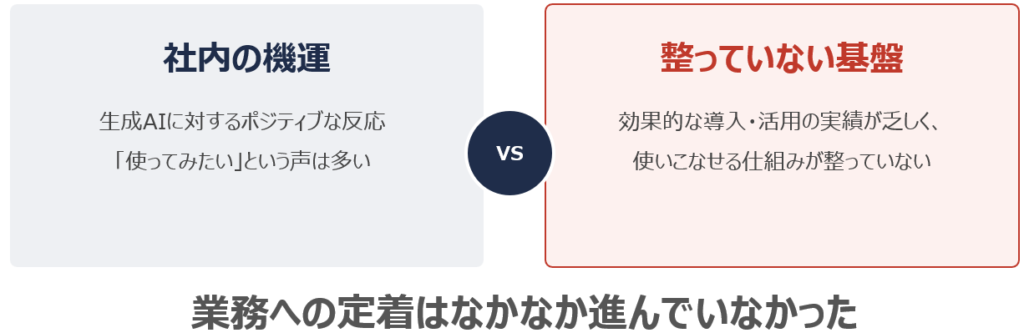
Figure: The gap of having enthusiasm but no platform
Redesign
ChatGPT-like usability and Teams integration: a platform that delivers “how to use it” along with the tool
The client’s top priority was usability that anyone could start with naturally. Built around a ChatGPT-like chat function, the platform was integrated with Microsoft Teams, which employees already used every day. By removing the burden of learning a separate new tool and embedding AI into existing workflows, it directly addressed the problem of AI going unused because people did not know how to use it.
The platform was also designed to run via API, so that each department’s business systems can call the AI directly without going through the chat UI. Designing it as a foundation that can be built into business systems across the company, rather than a standalone chatbot, gives it an extensibility that SaaS tools lack.
Compared with existing SaaS AI tools, the platform offered three key differentiators. On security, building it in-house on Azure means data is never passed to an outside vendor. On integration with internal knowledge, building it in-house provides the design freedom to connect it directly to existing internal documents and systems. On the cost of adoption and maintenance, with company-wide use in mind, a pay-as-you-go setup on Azure offers a cost advantage at scale over per-user SaaS licensing. These were the points the project emphasized.
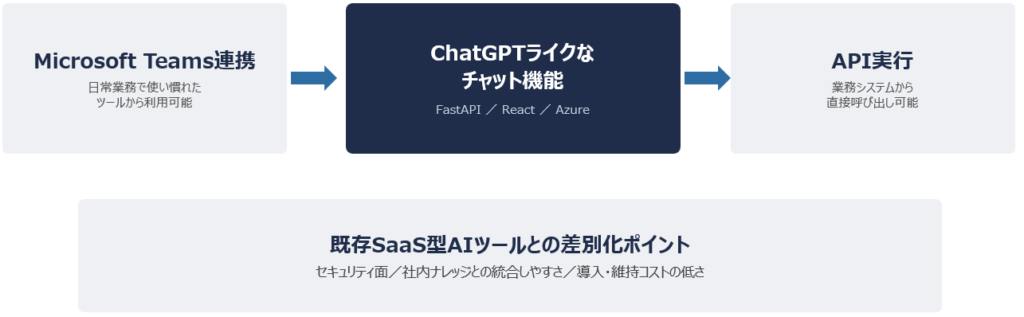
Figure: Architecture of the internal generative AI platform
The technology stack uses FastAPI for the back end, React for the front end, and Azure for infrastructure. While establishing the technical foundation for development, the project also kept in mind that building the platform was not the finish line. Working with the internal team responsible for promoting AI adoption, the rollout across the company went hand in hand with branding the app and providing AI training and education for employees.
After
An 80% registration rate, with generative AI now part of work across the company
As a result of the platform’s development and the promotion efforts, registered users reached about 80% of all employees. With ChatGPT-like usability and Teams integration, AI is no longer a special tool outside everyday workflows but something naturally built into daily work. A design intuitive enough to use without special training, together with touchpoints within existing workflows, helped employees who had stopped at “we’d like to try it” become regular users.
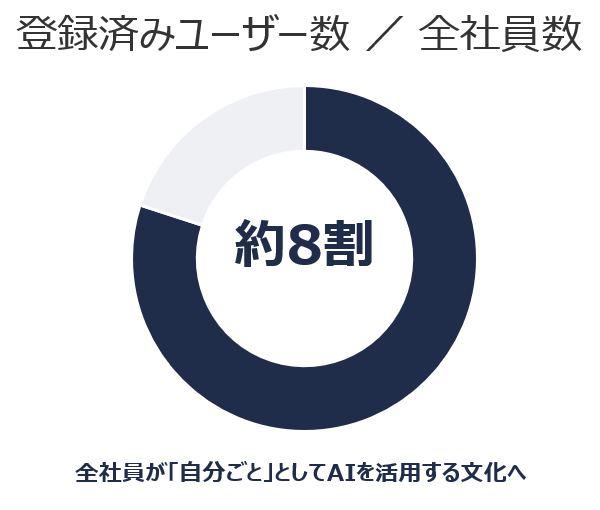
Figure: Registration rate results
Its advantages in security and cost have also earned the platform recognition as a sustainable internal AI foundation, not a passing trend.
If your organization has enthusiasm for generative AI but guidance on how to use it is not reaching employees, or finds that SaaS AI tools do not meet its security and cost requirements, we hope this case offers useful insights.