

Challenges and Results
Challenges
- Even after contract review was complete, the approval system was not connected, so staff had to download and re-upload contracts and enter contract information twice
- Approval routes branched in complex ways depending on contract type and amount (president, department manager, section manager, and so on), leading to human errors in routing decisions
Results
- Automated integration and routing with Power Automate are expected to save about 71.3 hours of work per month, or about 800 hours per year
- Prevented human errors in approval routing and built a relationship of trust with the legal department
Before
Gaps across the workflow that CLM alone could not close
The project began with a request from the legal department: “Our current system has reached its storage limit, and we want to switch to a new system with AI.” At first, the request was simply to help choose a vendor. As ITSO dug deeper into the department’s day-to-day work, however, two structural problems emerged that introducing a CLM (contract lifecycle management) system on its own would not solve.
The first was duplicate data entry after contract review was complete. Based on the reviewed contract, the requesting department had to route a separate internal approval request. Because the CLM and the approval system were not connected, staff had to download the contract and upload it again to the approval system. Information such as the counterparty and the terms of the agreement also had to be entered by hand in the approval system, and this double entry had become a burden.
The second was errors in determining approval routes. The final approver (president, department manager, section manager, and so on) varied in detail depending on the type and amount of the contract, and staff had been deciding the route case by case, so mistakes were not uncommon. Introducing CLM alone would not resolve these two gaps in the workflow, and the entire process needed to be reviewed.
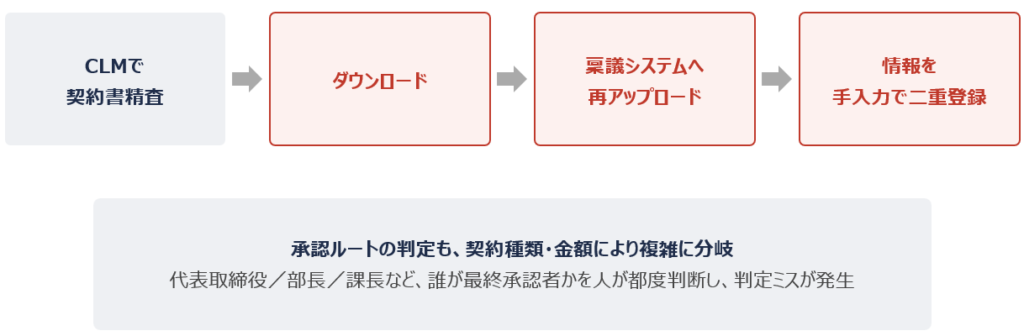
Figure: Workflow gaps that CLM alone cannot close
Redesign
Choosing OLGA after comparing three vendors, and connecting everything with Power Automate
Three vendors were compared in choosing the CLM product. Their AI contract review features did not differ much. The deciding factor was integration with external systems. Of the three, only one offered a built-in webhook function for sending data externally, a way to reliably pass reviewed contract information to the approval system. Without it, even a new CLM would leave the old manual work of downloading and re-uploading in place, so the presence of this external sending function decided the choice. Usability for legal department users and overall cost were also taken into account, and that CLM product was adopted.
For building the system, ITSO placed Power Automate at the center, because the legal and IT departments were already using Microsoft 365 across the company, keeping additional license costs and the effort of learning new tools to a minimum. ITSO built a mechanism that automatically determines the approval route from information entered in the CLM, such as contract amount and contract type, and automatically feeds the result into the approval document format in the approval system. Approval routing that staff once decided case by case is now automated, helping prevent routing errors. In addition, deciding whether a revenue stamp is required for paper contracts once meant sending a manual request to the accounting department each time. Now a request is sent automatically through data integration from the CLM.
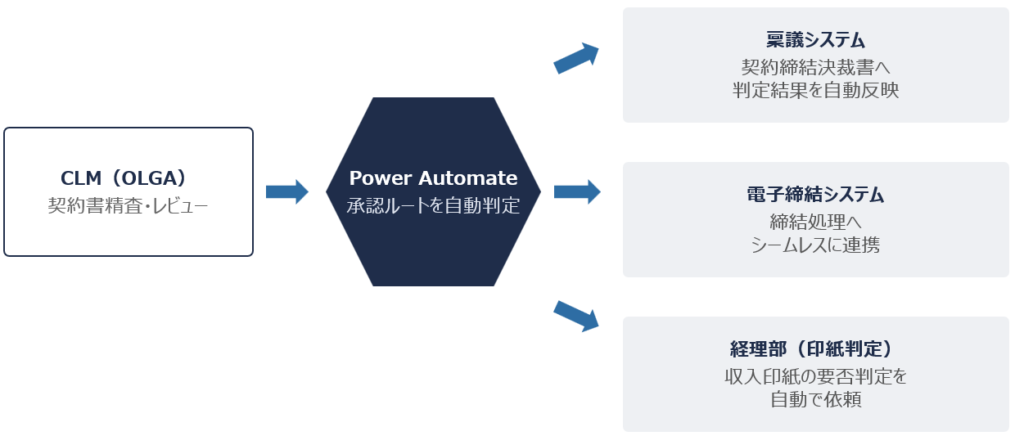
Figure: How Power Automate connects the entire workflow
Coordination shaped by another department’s late request and budget decisions
Midway through the project, just as the approval document format and approval routes were nearly finalized with the legal department, the newly established procurement department asked to use the same CLM platform. The design had to be revised to build the procurement department’s requirements into specifications that were almost settled, and fitting the differing requests of each department into a single system took considerable time to coordinate.
The “first-pass screening” expected of AI, and the gap with reality
At the start of the project, what the legal department most hoped AI would do was “first-pass screening”: having AI automatically assess the level of legal risk in incoming contracts (whether they contain unfavorable terms, such as the scope of liability or penalty clauses), so that low-risk contracts could go straight to approval without legal review. As requirements definition progressed, however, interviews with multiple vendors made it clear that the AI features of CLM products on the market were limited to review support that suggests revisions to contract wording, and that no product offered the screening judgment the legal department wanted.
For this project, therefore, AI was positioned only as support for contract review, and the project focused on making the overall workflow more efficient. As for the first-pass screening function originally hoped for, the team moved forward with adoption on the understanding that the CLM would be introduced first and further development would be taken up in the next phase.
After
Expected savings of 71.3 hours per month, or about 800 hours per year
Estimates based on a trial run in the legal department project savings of about 71.3 hours of work per month. That comes to roughly 800 hours per year, and together with the qualitative benefit of preventing human error by automating approval routing, the results point to a significant impact.
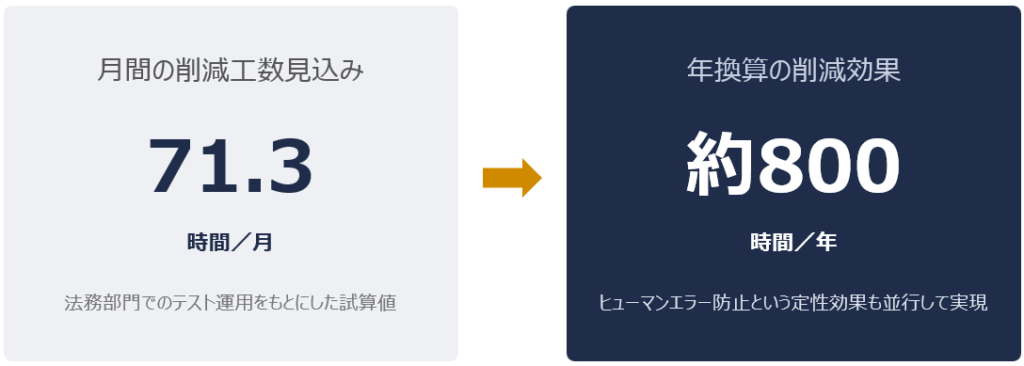
Figure: Expected savings
The project ran for a full year in close collaboration with the legal department, and a strong relationship of trust was built along the way. With the system release, this project has reached a milestone, and the “first-pass screening AI” that could not be delivered at first has already started as a new project developed jointly with the legal department. The trust earned as a team that worked alongside the client, rather than as an outside vendor, has led directly to the next initiative.