Challenges and Results
Challenges
- Under contracts that rebuilt the external vendor team for each project, requirements definition and handover started from scratch every time, driving up costs
- Repeated card brand integrations (M&A) had made data structures complex, and new development on core systems was frozen to keep the integration work safe
- On the front lines, there was strong demand to keep small operational improvements going, such as creating Excel macros and modifying RPA bots
Results
- Switched from per-project contracts to a “standing team” contract, with a team of four advancing five themes in parallel at all times
- Delivered 17 of 27 themes (the remaining 10 were handled in-house by the client after requirements definition or carried over to the next fiscal year)
- Achieved efficiency gains of about 47.6 person-months per year (about ¥200 million in annual savings). The largest impact came from automating data migration for the card brand integration
- Contributed, through sounding-board discussions of other companies' cases, to the creation of a new 58-person DX promotion department aimed at faster decision-making
Before
Three constraints, and frontline improvements that could not be stopped
Strict security rules specific to the financial industry had long made it difficult for frontline teams to improve their operations freely. In addition, repeated card brand integrations (M&A) had set off a migration to merge the existing systems into one. Any other system changes during the migration period would raise the risk of inconsistencies and problems, so to complete the migration safely, new development on core systems had been frozen for a long time. The integrations had also made the database structure itself more complex, adding to a situation in which outside vendors could not easily make changes.
Meanwhile, frontline teams had a strong, ongoing need to keep small operational improvements going, such as creating Excel macros and modifying RPA bots. The client also faced a structural problem: under the conventional approach of receiving outside support project by project, the team had to be rebuilt each time a new project came up, and everything from requirements definition to handover had to start from scratch, which added cost and time.
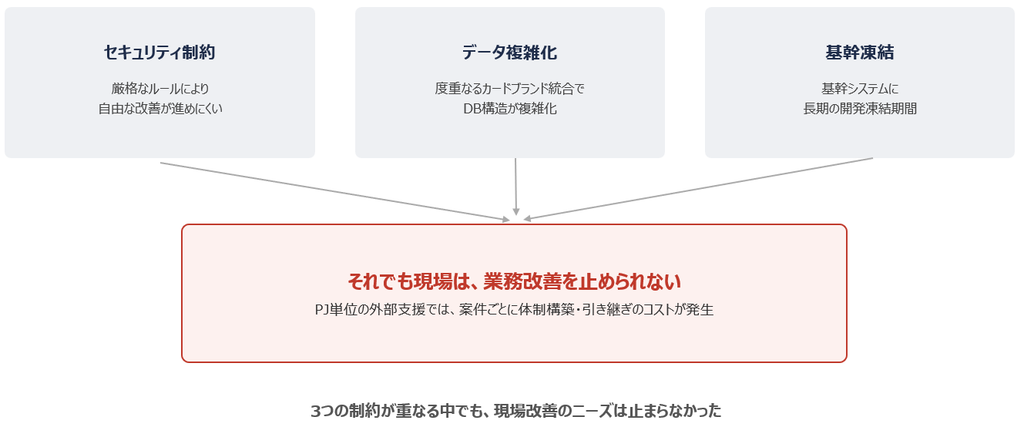
Figure: The dilemma of three constraints and frontline needs
Redesign
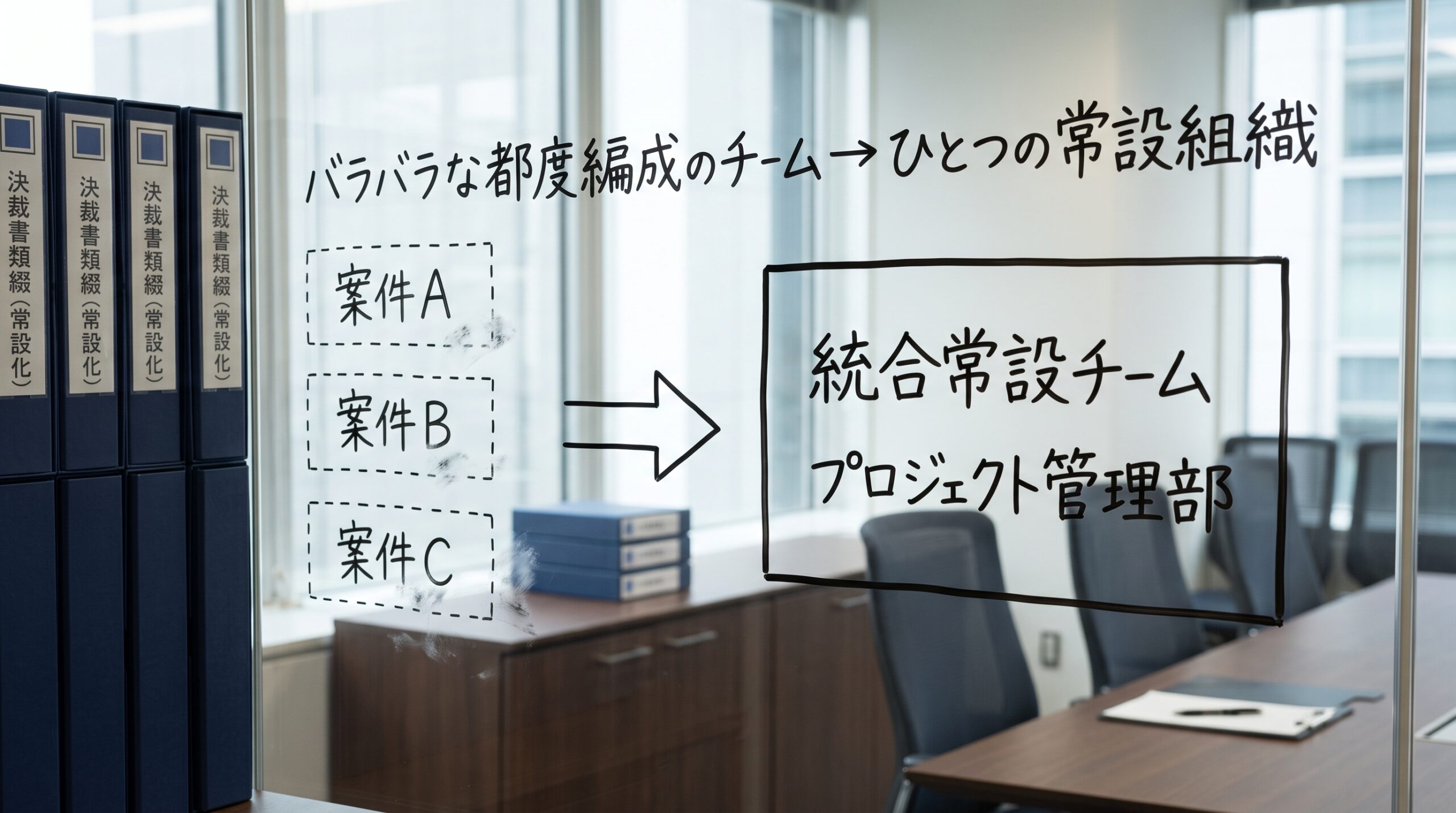
From project-based support to a “standing team” contract
To address this situation, the contract was changed to one that provides comprehensive, year-round support as a “standing team,” rather than support for individual projects. Engineering resources of four people were secured at all times, and the team was set up to advance five themes in parallel, with priorities decided mainly on cost-effectiveness.
ITSO handled overall oversight and backup, while a dedicated lead managed the assignment of development members and progress. By keeping resources in place on an ongoing basis, the arrangement eliminated the cost of building a team for each project and the losses that come with handovers.
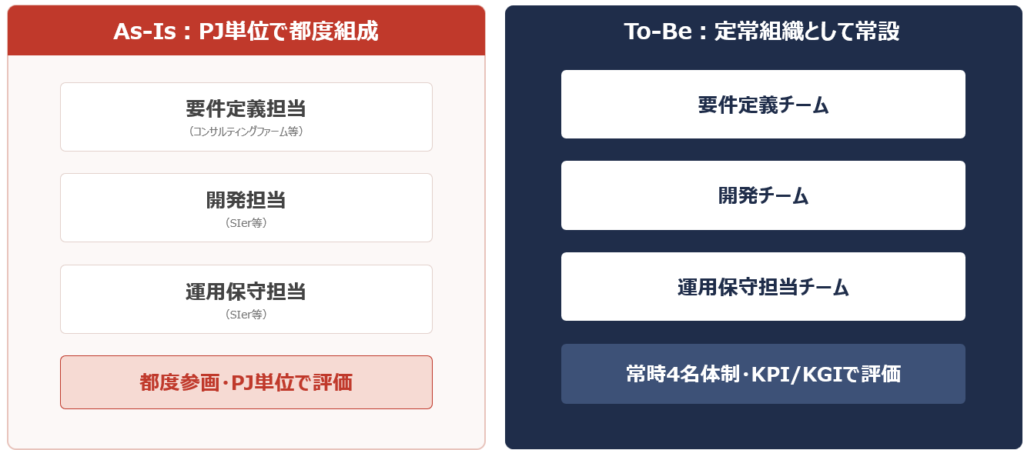
Figure: From project-based support to a standing team
Under this “standing team” framework, the following five themes were advanced in parallel. The ability to allocate resources and set priorities across multiple themes, rather than handling one-off development projects, is a strength unique to this form of support.
| ① Operational improvement / maintenance Defined individual issues raised by each department as 27 themes and delivered 17 of them |
| ② RPA environment optimization / host DB access policy Reviewed the cleanup of inactive RPA bots and the approach to accessing the host DB |
| ③ New technology adoption Provided hands-on training and adoption support for company-wide use of generative AI |
| ④ Planning for a new department Provided ongoing sounding-board support drawing on other companies’ reorganization cases |
| ⑤ Pre-proposal review of business processes Reviewed manual double entry and handoff costs in specific operations and proposed tool improvements |
The biggest efficiency gain, found in operational improvement and maintenance
Of the five themes, operational improvement and maintenance carried the most weight. Individual issues raised by each department were defined as 27 themes, and 17 of them were actually delivered. The remaining 10 were either handled in-house by the client after requirements definition was complete or carried over to the next fiscal year or later.
The project that produced the largest efficiency gain was data migration for the card brand integration. Replacing data matching and migration work that had depended entirely on manual effort with an automation tool delivered the largest savings of any single initiative.
Barriers in the RPA environment and in AI adoption, and the next steps they revealed
Under RPA environment optimization and host DB access policy, ITSO presented three approaches to cleaning up inactive RPA bots and stabilizing access to the host DB: direct retrieval via SQL, retrieval via API, and use of a shared RPA bot. From a license cost perspective, ITSO also tested migrating scenarios from the paid WinActor to Power Automate Desktop (PAD), which can be used free of charge within certain limits. However, the strict security constraints specific to the financial industry led to the conclusion that company-wide adoption would be difficult, and partly because of the freeze on core system development, discussion of a concrete improvement plan has been carried over to the next fiscal year or later.
Under new technology adoption, ITSO provided hands-on training for company-wide use of MS Copilot. Work hours saved exceeded the target, while the monthly active user rate and satisfaction fell short of their targets. Based on these results, ITSO planned an “ambassador program” in which each department chooses employees (ambassadors) to promote Copilot use and share concrete examples of using it in their work through monthly consultation sessions and study groups. A trial has begun in some departments.
After
47.6 person-months of accumulated gains, and what comes next
Under planning for a new department, the client faced a structural problem: authority was spread across departments, so it took time to move from decisions to action. ITSO provided ongoing sounding-board support, presenting other companies’ reorganization cases (such as setting up a dedicated department to oversee AI use and using company-wide collaboration tools). The final organizational design was developed in-house by the client, and it led to the creation of a dedicated department (58 people) that unifies DX promotion with the aim of speeding up decision-making.
Under the pre-proposal review of business processes, ITSO reviewed the manual double entry and handoff costs that had arisen in work passed back and forth by the Merchant Services Center and the Fukuoka Administration Center. ITSO proposed adding input support functions to the tools and simplifying the workflow itself, which reduced monthly manual work hours.
Despite the severe constraint of a freeze on large-scale core system development, operational improvement and maintenance alone delivered efficiency gains equivalent to about 47.6 person-months per year (about ¥200 million per year). The foundation for these results is the “standing team” form of support itself, which allows a continuous build-up of business understanding and prioritization across multiple themes, something that is hard to achieve with one-off projects.
For fiscal 2026, business process visualization (BPR) for Sales Division 2, which had requested support especially often, has been added as a new theme. Building on the business understanding developed as a standing team, ITSO also looks ahead to expanding the AI ambassador program company-wide and to continued hands-on support for the newly created DX promotion department.