Challenges and Results
Challenges
- Several small-scale tasks, such as updating master data in internal systems and creating invoices for external users, were understood by only one or a few people each, leaving the work dependent on specific individuals
- Some tasks had no written procedures at all, and input rules and exception handling relied on staff members' memory, creating a risk that the work would stop whenever the person in charge was absent
Results
- After organizing the work and documenting it in specifications, ITSO automated four tasks with UiPath, enabling other team members to carry out the work of staff who were about to leave their roles or go on leave
- Automation reduced work errors, cutting the time spent on checking deliverables and the number of checks required
Before
The risk of multiple tasks that only one person understood
Within the client company, there were several small-scale tasks, such as updating master data in internal systems and creating invoices for external users, whose details were known only to one person or a few people. Some of these tasks did not even have written procedures. Input fields and the criteria for handling exceptions relied solely on the memory of the staff in charge, creating a risk that the work itself would grind to a halt whenever that person was absent.
ITSO had previously supported the same client with UiPath automation through a separate business channel. This project began with a request from the client based on that track record.
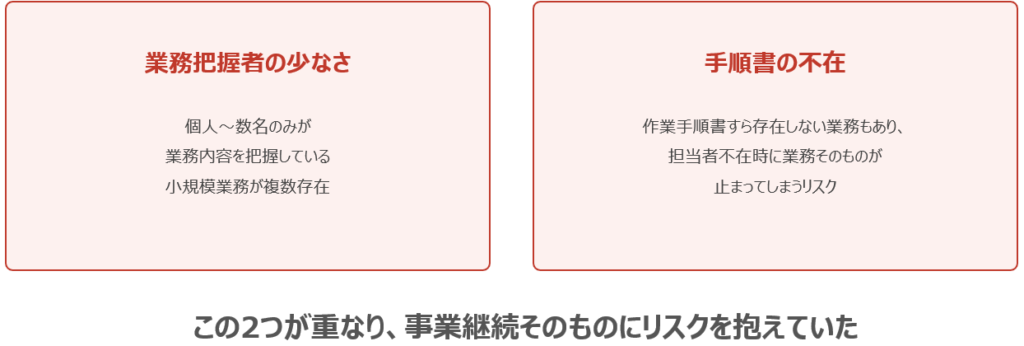
Figure: Two risks created by person-dependent work
Redesign
Organizing and documenting the work, then automating four tasks with UiPath
ITSO drove UiPath automation forward using a waterfall approach. The project covered four tasks: updating master data in internal systems, creating invoices for external users, creating import data for payment processing, and taking inventory of Jira issues.
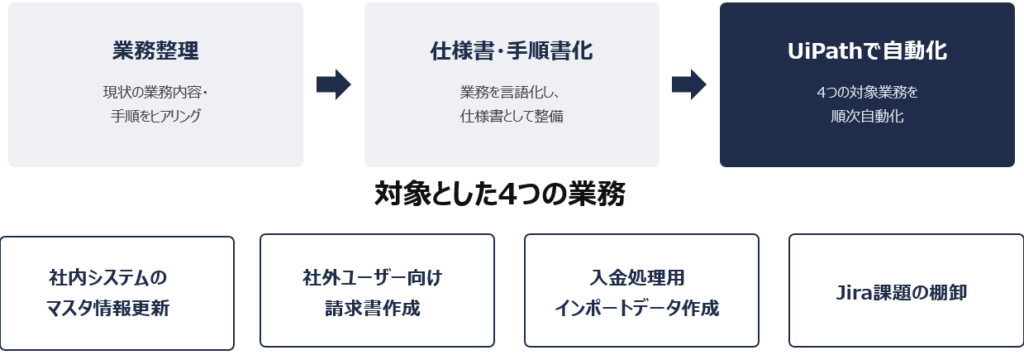
Figure: The approach, from organizing the work to automation
Organizing and documenting the work before automation
The key was not simply to automate with a tool, but to add a step before development began: organizing the content and procedures of each task and putting them into words as specifications and procedure manuals. Person-dependent work often hides exception handling and decision criteria that even the staff in charge apply without realizing it. If development proceeds without bringing these unwritten rules to light first, robots tend to stop on unexpected exceptions after launch, or specifications have to be reworked later.
Because ITSO did this organizing work first, automation could begin with the full scope and processing logic reflected without gaps, preventing rework after launch. These specifications and procedure manuals serve as the blueprint for automation, and they also put the work itself into words, turning knowledge that existed only in staff members’ heads into an asset for the organization.
After
Work that keeps running even when staff leave their roles or go on leave
The goal of this project was less about creating quantitative results and more about solving a qualitative problem: dependence on specific individuals. In fact, some of the staff in charge were scheduled to leave their roles or go on leave during the project. Through organizing the work before development, writing specifications, and automating with UiPath, the work can now be carried out by other staff members.
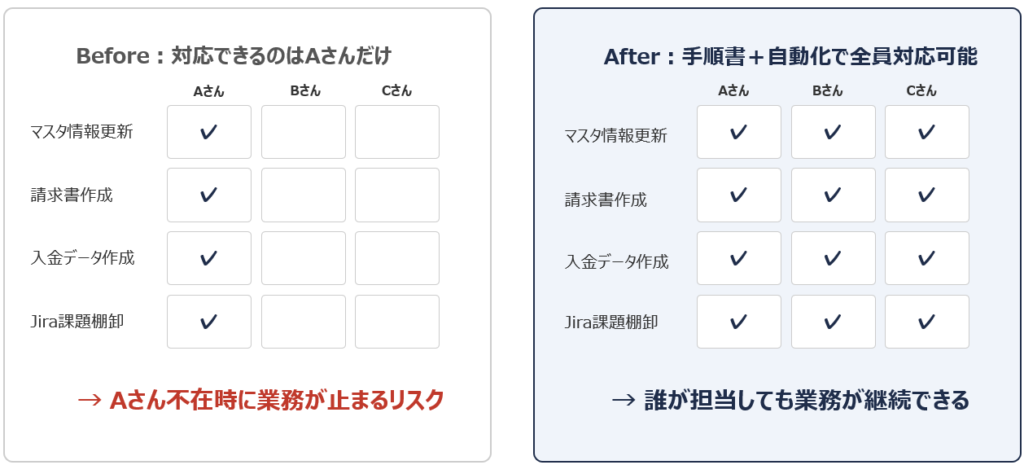
Figure: Changes in who can handle the work
In addition, errors caused by manual input and transcription were reduced at the source, allowing the team to switch to a process that requires fewer checks of deliverables. Eliminating person-dependence and stabilizing work quality were achieved together, as two sides of the same result.
If your organization has work that exists only in the heads of the people who handle it, or you want to eliminate person-dependence and automate at the same time, we hope this case offers useful insights.